- AIGC
- B2B2C
- Interior Design
Taimer.ai
An AIGC platform that pairs generative models with designer fine-tuning to turn a renovation brief into client-ready interior renders — in minutes, not weeks.
- Role
- Product Builder
- Team
- Taimer.ai · team of 5
- Timeline
- 7 months · 2023
- Tools
- Figma
Overview
A brief to client-ready renders, in minutes not weeks.
China's home-interior industry runs on slow, manual work: long back-and-forth with homeowners, renders drawn by hand, and lead-to-deal conversion that rarely pays back the cost of acquiring the lead. Taimer.ai set out to collapse that loop.
Over seven months, working with a team of five (a PM, me, a marketer, and two engineers), I designed a multi-modal AIGC platform — text-to-image, image-to-image, recognition, and 3D — that lets a designer fine-tune a model to their own house style, then generate client-ready interior renders in minutes. The work won the Outstanding Project award at the Tsinghua University AIGC Application Innovation Challenge and drew investment from Beijing institutions and angel backers.
The problem
A stack of small frictions, plus four structural barriers.
I started by mapping where designers and homeowners actually lose time. The friction wasn't one big thing; it was a stack of small ones.
High communication cost
Endless back-and-forth with homeowners drains time and energy.
Slow manual production
Producing renders by hand is painstaking and hard to scale.
Low conversion
Leads rarely turn into signed projects.
Blurry references
Stock imagery is unclear and low quality.
No acquisition channels
Designers lack reliable ways to reach new clients.
Lack of inspiration
Fresh creative starting points are hard to find.
On top of the day-to-day friction sit four structural barriers: the expertise the work demands, the difficulty of guaranteeing detail quality, cross-disciplinary tech that's gated abroad, and a delivery experience that keeps cost and timelines high.
Market opportunity
The upside of removing that friction is large.
Removing the friction pays off for the people doing the work and for the market around it.
Revision turnaround
Design-to-deal conversion
Brief → first proposal
N. American market
Designers in China
Beta renovation users
The product
A generation surface designers actually control.
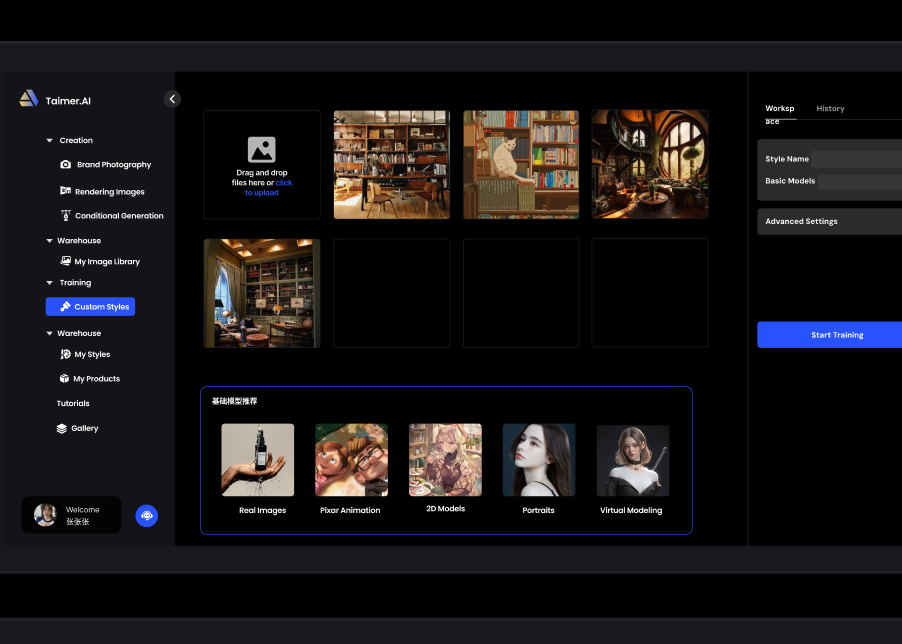
Taimer is a community-plus-creation platform. The core is a generation surface designers actually control, wrapped in tools that make a personal model worth building.
Interior generation
Upload a room, choose a type, then generate material styles, sketches, and floor plans — and expand, redraw, or annotate any region.
Creator tools
Custom style models, a style plaza, a personal image library, and asset management.
Fine-tuning controls
Image count, clarity, steps, learning rate, text intensity, sampler, seed, and copyright protection.

How it works
Fine-tuning is the feature — a designer’s style, not a generic one.
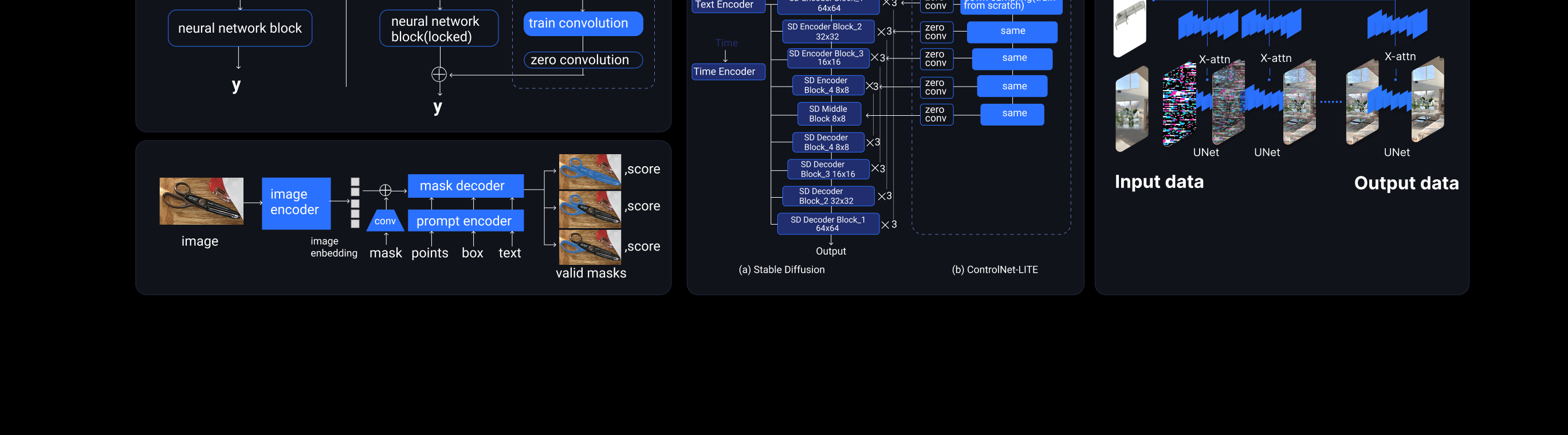
Under the surface, Taimer runs a proprietary deep-learning fine-tuning solution built on ControlNet and diffusion models, with multi-modal support and compute backed by AWS and NVIDIA. The point of the fine-tuning layer is control: a designer's model should reproduce their style, not a generic one.
Model training
Five stages to a style model
- 01Preprocess & label the designer's reference images.
- 02Prepare the datasets and configure the run.
- 03Train on the fine-tuning stack.
- 04Compare & select from candidate results.
- 05Tune weights until the output matches the target style.

Who it’s for
Built for independent designers and small studios.
The design centered on independent designers and small studios — people who need volume and consistency without a render farm.
Alex
33 · Changsha · Interior DesignerMotivation
- Serve more clients and finish projects faster
- Generate large volumes of low-cost drafts with AI
- Offer varied styles for different clients and markets
Needs
- Models that match the firm's house style
- Convenient fine-tuning tools
- Less manual back-and-forth with homeowners
Business model
Designers subscribe; product brands pay per usage.
The tiers map to how many drafts a studio actually ships in a month.
Basic
¥59/mo10 orders / month
Standard
¥399/mo100 orders / month
Pro
¥1999/mo400 orders / month
Inventory listing
¥699Upload 10 SKUs · pay-per-usage
Behind the subscription, a designer requests a customized model, a training expert builds and tracks it, candidate outputs are reviewed together, and the result is delivered — with evaluation and after-sales support if it isn't right the first time.
Impact
From a week to an hour, and +45% conversion.
Revision turnaround, down from a week to an hour
Lift in design-to-deal conversion
Renovation users reached in beta
Beyond the numbers, Taimer opened a new income stream for independent designers and gave consumers a one-minute path from brief to first proposal. The lesson that stuck with me: in an AIGC tool, control is the feature — the fine-tuning that makes a model feel like the designer's own is exactly what makes the output worth paying for.